
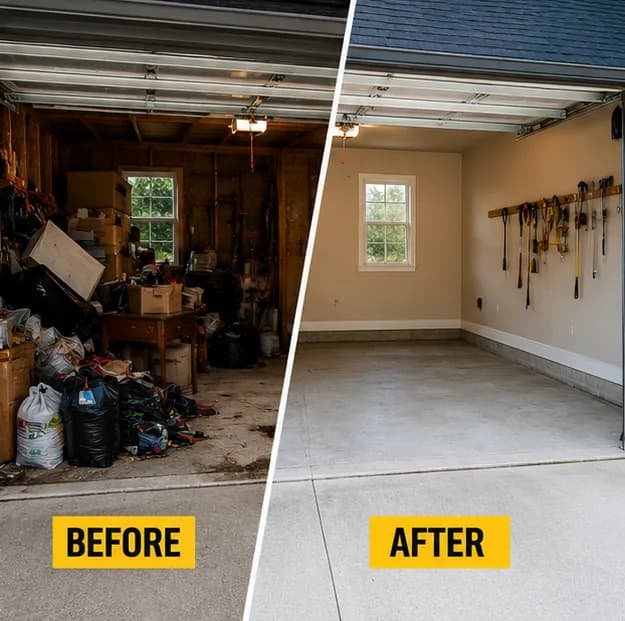
Garage cleanouts fail in a predictable way. Someone pulls everything onto the driveway on a Saturday morning, discovers there is far more of it than expected, runs out of daylight, and puts most of it back. The garage is now slightly worse than it was.
The problem is almost never effort or motivation. It is sequence. A garage holds the widest mix of material in the house — furniture, appliances, lumber, yard tools, chemicals, sports equipment and boxes nobody has opened since the last move — and each of those has a different destination. Trying to sort them in one undifferentiated pile is what runs out the clock.
Start by deciding what the garage is for
This sounds like a soft question but it is the one that makes every later decision fast. A garage that is going to park two cars has roughly a metre of perimeter storage available and nothing else. A garage that is a workshop has different constraints. A garage that is genuinely a storage room can hold a lot more.
Write the answer down before you touch anything. When you are later holding a broken chair and wondering whether to keep it, the decision is no longer about the chair — it is about whether it fits the plan you already committed to. That is a far easier question.
Pull the hazardous materials out first
Do this before anything else, because it is the one category that cannot be dealt with on the day and will otherwise block the end of the job.
Paint, stain, solvents, gasoline, motor oil, antifreeze, propane cylinders, pool chemicals, pesticides and car batteries are all household hazardous waste. They cannot go in your regular trash, they cannot go on a junk removal truck, and a single leaking can in a load can contaminate the whole thing.
- Set them aside in one clearly separated spot, away from the rest of the sort
- Check your county's household hazardous waste program — most run free drop-offs for residents
- Latex paint is often the exception: once fully dried out it can usually go in regular trash, but confirm locally
- Auto parts stores commonly take used motor oil, antifreeze and vehicle batteries
- Propane exchange programs handle standard barbecue cylinders
Sort into four piles, not three
The standard advice is keep, donate, toss. Add a fourth — 'decide later' — and give it a hard cap: one bin, and only one.
The reason is that indecision is what stops a cleanout. Two or three items will genuinely need a conversation with someone else, or a check on whether a part is still available. Letting those sit in a capped bin keeps the rest of the job moving. Without the bin, each of those items stops the whole process while you think about it.
When the bin is full, it is full. Anything else has to land in one of the other three piles.
Work the perimeter, not the middle
Garages are usually packed to the walls with a path down the centre. The instinct is to start with whatever is most annoying, which is normally in the middle.
Work one wall at a time instead. It gives you cleared floor to stage the sorted piles on, which is the resource you run out of fastest, and it produces visible progress early. A cleared wall at the ninety-minute mark is what gets the job finished; a churned middle at the same point is what ends it.
Open the boxes
The boxes nobody has opened in five years are the emotional core of a garage cleanout, and there is no way around them. What is inside is almost always one of three things: genuinely valuable and forgotten, sentimental and worth keeping properly, or packing material and old paperwork.
Open them during the cleanout, not after the truck has left. The most common regret people report after a removal is not that they got rid of too much — it is that something they wanted was inside a box they never opened.
Book the removal for the same day, not for 'later'
A sorted garage with three large piles in the driveway is not a finished job. It is a finished sort, and it will migrate back into the garage by Tuesday if nothing collects it.
Book the haul for the afternoon of the cleanout, or for the next morning at the latest. The crew removes the toss pile from wherever it sits — the driveway, the garage, the back yard — so there is no need to stage it neatly at the curb.
If you are unsure how much you will have, send a photo of the garage as it is now when you request the quote. Volume is very difficult to describe in words and very easy to show, and it is the single biggest driver of the price.
What it costs, roughly speaking
Garage cleanouts are priced by how much of the truck the load fills. A tidy single-car garage is often a quarter load; a genuinely packed two-car garage is frequently a half truck or more.
Two things push it up beyond volume. Dense material — concrete, tile, soil, masonry — is priced by weight rather than space, because it hits a truck's legal limit before it fills it. And certain items carry a per-unit facility fee that gets passed through: refrigerators and freezers, mattresses, televisions and tires are the ones that turn up in garages most.
If you know you have any of those, mention them when you request the quote. It is the difference between a number that holds and a number that changes on the day.